Showing posts with label hair loss prevention. Show all posts

Wednesday, November 30, 2011

Nightmare on Hair Street

One Woman's Horror Hair Story Regarding Extensions

MY NAME IS LINDSEY HENDRICKSON and I have always experienced fine thin hair. Some days there was nothing I could do with my hair at all. I learned ways to hide the thinness by styling it a certain way. A good friend of mine, who is a licensed stylist, suggested that I get hair exten- sions. I was excited thinking I would finally get the chance to have this thick, beautiful hair.

I went to a stylist and as she applied the hair ex- tensions, I noticed she was using glue. My first application was great, I could curl them and treat them just like it was my own hair. After a few days, after the newness had worn off, they felt very heavy and gave me extreme head- aches. I had a hard time blending them as they always looked stringy. Trying to brush my hair was difficult even with a special loop brush. I had my extension for about two months and struggled with them everyday. I went back to the salon and it took three hours to remove them.

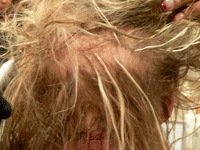
The stylist convinced me there was no damage and I could do it again. The second application of extensions was worse. They were more of a struggle than the first. I had already lost some hair from the weight of the extensions, breakage, the glue, and chemicals used. When I had them removed the second time, the stylist did not want me to come to the salon to do it. We went to her home, I thought it was odd but I was desperate to get them out. My hair was completely damaged and broken. The dreadlocks could not be combed out, they needed to be cut out. I was at a point where I did not know what to do. I sought out advice from an extension expert.

According to her I had no choice but to put them back in my hair to hide the areas that had been thinned out even more. The new “hair extension expert” proceeded to apply extensions to the little hair that was left. Neither of these stylists informed me of any risks associated with hair extensions. There was no maintenance contract given to me, nor did they discuss the pros and cons with me. I assumed, like many others, that thousand’s of people get extensions so they know what they are doing. After all they are “licensed stylists.” Wrong! Six months into this and I did not know what to do. I was desperate and my hair was a mess.

I finally went to a hair restoration specialist, who in fact cringed when she saw my hair. She could not believe the damage that had occurred in only six months. I am thankful everyday that I made the decision to go see the hair restoration specialist. She managed to save my self esteem as a woman.


From Our Hair Restoration Specialist:
This story is not uncommon. On average this happens to about 80% of hair extension clients. One of the biggest misconceptions is that hair extensions are the only option to fix fine thin hair. In fact, there are hundreds of options from products, pieces, units and basic hair maintenance. It may even be determined that hair extensions are not the answer for you. There are pros and cons to each type of hair extensions. Information that should be discussed during your consultation include: hair and extension maintenance, application and removal frequency, any chemicals, glues or products used, hair type and your lifestyle. Lack of information and improper care are the biggest reasons people often have a bad experience. Hair extension baldness is the most common problem that results from improper application and removal of hair extensions. There are many times that the damage will be irreparable. If you notice any type of breakage, dreadlocks or your stylist does not allow you to see the back of your hair, you probably need some help. There is no easy solution in fixing the damage that extensions can cause.

Creating the best and healthiest environment is the your hair and scalp. A hair restoration specialist can recommend the right products and services that can, over time, restore your hair and repair the damage. Be sure to ask the proper questions, review all of your options and consult with more than one person. Also, ask the stylist if you can contact and see other clients with extensions. Do not be afraid to be told that you cannot have them. It may be a blessing in disguise. Do not go with the cheapest stylist and product either, they can cost you a lot more in damage and repair later. Do your research and educate yourself. It pays off in the long run.

For more information on Hair Extension Options...visit our Hair Extension Page on our Website!

This article was published In Northwest Womans Magazine in 2008! If you would like a copy of the article, please email info@crowningglorystudios.com

Wednesday, October 19, 2011

Medications and Hair Loss

If you are experiencing sudden hair loss, thinning or shedding, consider whether any medication you are taking could be causing this.

“Hair loss can be caused by so many different reasons, but one common cause is that it could be a side effect of a medication you have just begun or have been taking regularly,” says Dr. Eric Schweiger, a New York City dermatologist and hair transplant surgeon. “So when patients come to us with hair loss or thinning, one of the first questions we’ll ask is about medications they are currently taking.”

How do medications cause hair loss?

Schweiger explains that there are two ways medications can cause hair loss. One way is from telogen effluvium, where hair follicles get shocked by a drug and moved away from the regular growth phase into a resting phase, which pushes hairs out and causes diffuse (widely spread) and noticeable fall-out. Anagen effluvium happens when a strong drug or medication, such as chemotherapy, attacks hair follicles and other rapidly dividing cells in the body, causing all hair to fall out suddenly and completely. “Either way, the results can be quite shocking, or you may just notice a little bit of hair fall-out or shedding when you first start taking the drug,” says Schweiger. “You owe it to yourself to work with your physician to determine if your medications are the cause of your hair loss.”

Is this hair loss side effect of my medication permanent?

“It depends on the person,” says Schweiger, who further explains that no one drug will affect everybody’s hair follicles or other body systems in exactly the same way. Sometimes the body adjusts to the ingestion of the drug on a regular basis and the hair grows back eventually, and sometimes hair continues to fall out and does not grow back as long as you continue taking the medication. “One option is to keep taking the medication, if necessary, to see if the hair loss condition improves and your hair grows back, and your other option is to discontinue the medication if possible,” he advises.

The five most common medications that cause hair loss

As a dermatologist and hair loss specialist, Dr. Schweiger explains that the following commonly prescribed medications are most often associated with side effects that include hair loss, diffuse thinning, shedding and fall-out, in varying degrees depending on the person:

  • Beta-blockers (blood pressure medications)
  • Oral birth control pills
  • Accutane
  • Antidepressants (serotonin reuptake inhibitors, or SRIs)
  • Cholesterol-lowering drugs

But why do these common medications cause hair loss? Dr. Schweiger explains, “It’s just not black and white … It’s more personal and how the medication affects you. We just don’t have any good clinical studies that prove that any medication will definitely cause hair loss in someone or why it doesn’t cause hair loss in someone else. We also don’t know whether patients’ regular hair growth will resume eventually if they continue taking any particular medication. One thing we do know,” he concludes: “None of these medications cause scarring permanent hair loss, and usually hair growth resumes when the offending medication is discontinued.”

Tuesday, November 30, 2010

Become a Hair Loss Expert

DID YOU KNOW? According to a popular theory, humans have evolved beyond needing any hair. But when hair loss begins, it seems we can’t live without it!

Hair seems to define us, doesn’t it? But it also defines us as being a mammal, scientifically speaking, and anthropologically and archaeologically, evidence suggests that we have had hair (or fur) since before we stood up on two legs. Back then, goes the theory, humans needed protection from the elements such as extreme cold and ultraviolet radiation from the sun, so fur was a form of protection for our skin. As humans evolved with less of a need for that protection, body hair declined over the centuries. Once we learned how to wear animal furs and use bark and leaves as coverings, hair lost its protective value and restricted itself to just the areas on the human body we know of today. And most of those places are the focus of multibillion-dollar-a-year industries bent on removing the hair; but on the head it is the opposite: We spend as much time and money as possible devoted to keeping our hair and showing it off.

As such, hair bears great social significance in terms of defining a person’s identity. And when something happens to our hair -- such as a hair loss disease (for example, alopecia areata) or, on the other end of the spectrum, excessive hair growth on the body or even just a temporary accident -- we suffer great trauma as a result. Your hair can also identify you as a member of a certain social group, such as hippie, punk or prep or of a geographic, ethnic or religious group. As each displays its own defining characteristics, you can almost always spot an Orthodox Jew by his earlocks and tall hat, a Muslim by her hijab, a Rastafarian by his uncut dreadlocks. And, the act of shaving the head can symbolize punishment or purity depending on the situation. In fact, hair is also an indicator of health, with thinning or missing hair often an indicator of sickness.

Want to better understand hair loss? Then become a hair loss expert yourself.

Top-ten facts to give you a deeper understanding of hair loss and how to prevent hair loss:

  1. The length of a piece of hair has three parts: the root, which lies in the follicle beneath the scalp; the bulb, which is the swelling at the base of the scalp; and the shaft, which is the strand above the scalp (that shows).
  2. A cross section of a piece of hair also has three parts, and these are concentric. From the inside out: The medulla is the inner core of the hair; the cortex surrounds it in a layer of densely packed keratin; and the cuticle is hair’s outer, clear, protective layer made up of scales that overlap and lay flat, like roof shingles.
  3. The cortex of the hair is the part that is penetrated and altered when you have a chemical process performed on your hair. The cuticle is the outer layer that gets roughed up by too much brushing, rubbing, heated styling-tool exposure and harsh chemicals, most often responsible for frizzy-looking, dull hair.
  4. It’s the irregular shape of the hair follicle that determines whether your hair will be curly, kinky or wavy.
  5. The sebaceous gland associated with each hair follicle is largely responsible for secreting hair’s own natural protection.
  6. The reason that hair transplantation can be so successful is that each follicular unit is complete and can be removed and replaced to a new location in much the same way you transplant a garden plant with its roots attached.
  7. A person’s individual hair growth cycle, which can last from two to seven years, dictates his or her ultimate hair length, if it was not cut for that long. The “ anagen” phase is a period of active growth and hair follicle regeneration. The “ catagen” phase is when that follicle stops growing new hair, which often results in natural, normal hair shedding. Next is the “ telogen” (resting) phase, in which the follicle remains dormant for a few months until it is reawakened by a new anagen growth phase. “ Exogen” is the term that describes hair shedding as old hairs become dislodged by new ones, which usually takes place at the onset of a new anagen phase.
  8. Because of these phases, it’s important to realize that natural hair shedding of 100-200 hairs daily is perfectly normal and a natural part of hair growth. This is not considered to be the hair loss we dread.
  9. Different ethnic hair types exhibit varying rates of growth: The average growth rate for Caucasian hair is about one-quarter inch per month, although hair growth can occur faster in children. Afro-Caribbean hair grows approximately half as fast as the Caucasian because of its fragile structure, and it rarely grows very long, either. Asian hair grows even faster than Caucasian hair and, as a result, grows even longer because of its thicker structure.
  10. The top-six normal things that can affect your hair’s growth and health are hormonal changes, daily care, medications, stress, fungal or other infections and aging.

Now that you’re an expert and have a better understanding of what’s considered “normal” for hair, you’ll be able to identify any hair loss or hair-thinning concerns or issues you have and learn to better prevent hair loss and keep the hair you have.