Showing posts with label Hair Loss Information. Show all posts

Wednesday, November 30, 2011

Nightmare on Hair Street

One Woman's Horror Hair Story Regarding Extensions

MY NAME IS LINDSEY HENDRICKSON and I have always experienced fine thin hair. Some days there was nothing I could do with my hair at all. I learned ways to hide the thinness by styling it a certain way. A good friend of mine, who is a licensed stylist, suggested that I get hair exten- sions. I was excited thinking I would finally get the chance to have this thick, beautiful hair.

I went to a stylist and as she applied the hair ex- tensions, I noticed she was using glue. My first application was great, I could curl them and treat them just like it was my own hair. After a few days, after the newness had worn off, they felt very heavy and gave me extreme head- aches. I had a hard time blending them as they always looked stringy. Trying to brush my hair was difficult even with a special loop brush. I had my extension for about two months and struggled with them everyday. I went back to the salon and it took three hours to remove them.

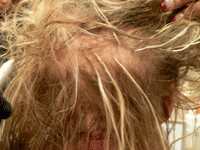
The stylist convinced me there was no damage and I could do it again. The second application of extensions was worse. They were more of a struggle than the first. I had already lost some hair from the weight of the extensions, breakage, the glue, and chemicals used. When I had them removed the second time, the stylist did not want me to come to the salon to do it. We went to her home, I thought it was odd but I was desperate to get them out. My hair was completely damaged and broken. The dreadlocks could not be combed out, they needed to be cut out. I was at a point where I did not know what to do. I sought out advice from an extension expert.

According to her I had no choice but to put them back in my hair to hide the areas that had been thinned out even more. The new “hair extension expert” proceeded to apply extensions to the little hair that was left. Neither of these stylists informed me of any risks associated with hair extensions. There was no maintenance contract given to me, nor did they discuss the pros and cons with me. I assumed, like many others, that thousand’s of people get extensions so they know what they are doing. After all they are “licensed stylists.” Wrong! Six months into this and I did not know what to do. I was desperate and my hair was a mess.

I finally went to a hair restoration specialist, who in fact cringed when she saw my hair. She could not believe the damage that had occurred in only six months. I am thankful everyday that I made the decision to go see the hair restoration specialist. She managed to save my self esteem as a woman.


From Our Hair Restoration Specialist:
This story is not uncommon. On average this happens to about 80% of hair extension clients. One of the biggest misconceptions is that hair extensions are the only option to fix fine thin hair. In fact, there are hundreds of options from products, pieces, units and basic hair maintenance. It may even be determined that hair extensions are not the answer for you. There are pros and cons to each type of hair extensions. Information that should be discussed during your consultation include: hair and extension maintenance, application and removal frequency, any chemicals, glues or products used, hair type and your lifestyle. Lack of information and improper care are the biggest reasons people often have a bad experience. Hair extension baldness is the most common problem that results from improper application and removal of hair extensions. There are many times that the damage will be irreparable. If you notice any type of breakage, dreadlocks or your stylist does not allow you to see the back of your hair, you probably need some help. There is no easy solution in fixing the damage that extensions can cause.

Creating the best and healthiest environment is the your hair and scalp. A hair restoration specialist can recommend the right products and services that can, over time, restore your hair and repair the damage. Be sure to ask the proper questions, review all of your options and consult with more than one person. Also, ask the stylist if you can contact and see other clients with extensions. Do not be afraid to be told that you cannot have them. It may be a blessing in disguise. Do not go with the cheapest stylist and product either, they can cost you a lot more in damage and repair later. Do your research and educate yourself. It pays off in the long run.

For more information on Hair Extension Options...visit our Hair Extension Page on our Website!

This article was published In Northwest Womans Magazine in 2008! If you would like a copy of the article, please email info@crowningglorystudios.com

Wednesday, November 2, 2011

New Before and After Videos

Great New Before and After Pictures and options for Men, Women and Children Suffering from all forms of hair loss.

Crowning Glory Studios offers safe and healthy options to help enhance and restore your natural growing hair.

We specialize in hair extensions, scalp conditions, chemotherapy, genetic hair loss, alopecia and much more!


You can call today for a no obligation consultation at 509-926-6429 for a Spokane Appointment and 425-455-4247 for a Bellevue Appointment. We offer private rooms for your privacy and confidentiality!

Wednesday, October 19, 2011

Medications and Hair Loss

If you are experiencing sudden hair loss, thinning or shedding, consider whether any medication you are taking could be causing this.

“Hair loss can be caused by so many different reasons, but one common cause is that it could be a side effect of a medication you have just begun or have been taking regularly,” says Dr. Eric Schweiger, a New York City dermatologist and hair transplant surgeon. “So when patients come to us with hair loss or thinning, one of the first questions we’ll ask is about medications they are currently taking.”

How do medications cause hair loss?

Schweiger explains that there are two ways medications can cause hair loss. One way is from telogen effluvium, where hair follicles get shocked by a drug and moved away from the regular growth phase into a resting phase, which pushes hairs out and causes diffuse (widely spread) and noticeable fall-out. Anagen effluvium happens when a strong drug or medication, such as chemotherapy, attacks hair follicles and other rapidly dividing cells in the body, causing all hair to fall out suddenly and completely. “Either way, the results can be quite shocking, or you may just notice a little bit of hair fall-out or shedding when you first start taking the drug,” says Schweiger. “You owe it to yourself to work with your physician to determine if your medications are the cause of your hair loss.”

Is this hair loss side effect of my medication permanent?

“It depends on the person,” says Schweiger, who further explains that no one drug will affect everybody’s hair follicles or other body systems in exactly the same way. Sometimes the body adjusts to the ingestion of the drug on a regular basis and the hair grows back eventually, and sometimes hair continues to fall out and does not grow back as long as you continue taking the medication. “One option is to keep taking the medication, if necessary, to see if the hair loss condition improves and your hair grows back, and your other option is to discontinue the medication if possible,” he advises.

The five most common medications that cause hair loss

As a dermatologist and hair loss specialist, Dr. Schweiger explains that the following commonly prescribed medications are most often associated with side effects that include hair loss, diffuse thinning, shedding and fall-out, in varying degrees depending on the person:

  • Beta-blockers (blood pressure medications)
  • Oral birth control pills
  • Accutane
  • Antidepressants (serotonin reuptake inhibitors, or SRIs)
  • Cholesterol-lowering drugs

But why do these common medications cause hair loss? Dr. Schweiger explains, “It’s just not black and white … It’s more personal and how the medication affects you. We just don’t have any good clinical studies that prove that any medication will definitely cause hair loss in someone or why it doesn’t cause hair loss in someone else. We also don’t know whether patients’ regular hair growth will resume eventually if they continue taking any particular medication. One thing we do know,” he concludes: “None of these medications cause scarring permanent hair loss, and usually hair growth resumes when the offending medication is discontinued.”

Saturday, October 8, 2011

Water Wig? Huh?

COMING SOON!

....so what would you say to a 16" Water Wig? Looks, acts and feels just like real hair!

  • Water goes right through the wig and it doesn't come off
  • Can be worn comfortably for ACTIVE USE
  • You're out the door looking gorgeous in minutes
  • The look of fine Russian Hair
  • High Grade Light Synthetic
  • EASY MAINTENANCE
Stay tuned for more information!

Friday, October 7, 2011

Four New Children's Wigs

We are introducing FOUR new Children's Wigs!


When we think of our children, we want to experience nothing but happy thoughts. Unfortunately, there are nearly 2 million children suffering from some sort of hair loss in the United States.

Crowning Glory can give these children the chance to feel good about themselves again.

We have so many options available for each and every child that enters our salons. With our talented hair replacements professionals, you can rest assured that we treat each and every child like they are our own! We offer durable and long lasting wigs and hair pieces, that allow children to truly be children. They can swim, play, hang from trees, and feel like themselves again!

With Four new options available, we can address the sensitive subject of children's medical hair loss. The new wigs available are available in European Human Hair and one available in Synthetic fibers.

The four design accomodate petite heads of 19" and are ideal for children, pre-teens and young adults. There are vibrant colors available that are specifically blended to achieve a youthful and natural flowing look that will satisfy your child's needs.


Call 509-926-6429 to make an appointment in Spokane or 425-455-4247 to make an appointment in Bellevue for a consultation for your child!


Wednesday, September 28, 2011

New Raquel Welch Wigs Coming

Raquel Welch's New 2011 Fall Collection Now Available at Crowning Glory Studios

With fall rapidly approaching, the alternative hair industry continues to stay ahead in the changing needs of women who have come to expect the best quality, style and function in hair fashions.

Crowning Glory Studios, continues to add to their inventory, the most current, cutting--edge wig styles, unveiling the new Raquel Welch Wigs Fall 2011 Collection just in time for the season.

With Hollywood celebrities continuing the set the standard for what is hot, here and now in fashion, the Raquel Welch Collection of wigs and hairpieces by HairUWear is no exception to the rule with what is hot in hair fashions. Newly released are: 6 new Freeform™ Tru2Life heat-friendly synthetic wig styles, 1 new Signature Collection style, 1 new human hair wig, and 1 clip-in human hair bang to complete this season.

Smouldering styles featuring lace front constructions, monofilament top, and 100% hand-knotted bases, are as natural looking and versatile as you have come to expect from the Raquel Welch Collection include:

  • Opening Act: a heat-friendly layered, face-framing cut with a below the collar nape, featuring a Sheer Indulgence lace front monofilament top.
  • Limelight: long layered waves that fall to mid-back in heat-friendly hair fiber with a Sheer Indulgence lace front monofilament top.
  • Encore: a barely waved, face framing cut that falls below the shoulders in heat-friendly fiber featuring a Sheer Indulgence lace front monofilament top.
  • Finesse: a heat-friendly below the chin length page wig with a graduated collar length nape finished with a Sheer Indulgence monofilament crown and Memory Cap II base.
  • Magic: a perfectly straight, layered below the shoulders style in heat-friendly fiber with a Sheer Indulgence monofilament crown.
  • Sparkle: a short, face framing cut with smooth hair and textured layering in heat-friendly fiber with a Memory Cap II base.
  • Winner Elite: a stepped up version of the popular Winner Wig style with the added luxury of a Sheer Indulgence monofilament top, lace front construction and 100% hand-tied base.
  • Bravo: the ultimate in luxury long and lush 100% human hair long length style with a Sheer Indulgence monofilament top, lace front construction and 100% hand-knotted base.
  • Clip-In Human Hair Bang: a face framing 100% human hair bang with a monofilament base that adds customized fashion without cutting your own hair.

"Change your mind. Change your mood. Change your style!"
The most stylable, most wearable, most versatile hair ever: FREEFORM
Glamour now-Is the oportunity to create any styleyou want. You make it beautiful…we make it easy. Flat iron, curl, or blow dry our Tru2Life® heat-friendly fiber and create a totally new style in a flash. What does it feel like? Like your own hair, only better. What does it look like? Like you’ve got your own live-in stylist.

Monday, September 19, 2011

Our Hollywood Leading Men - Their Hair or Not

More than ever, today's movie stars make more of an effort than Hollywood's "Golden Age" stars to conceal their hair loss from the public.

Recently, HairLossDotCom ran an article called “Hair Wearing Hollywood Stars” that looked mostly at movie stars of the past who disguised their hair loss on screen. This, clearly, is a situation that still exists today.

As a matter of fact, it could be argued that Hollywood stars today make even more of an effort to disguise receding hairlines, thinness and outright baldness than did the men who filled the silver screen in its so-called Golden Age.

Why should this be? Well, there are several reasons.

First, men in general – not just Hollywood stars, but everyday Joe’s – are more likely to be taking steps to disguise hair loss in order to feel more confident and comfortable in their daily lives.

Sixty years ago, a Jimmy Stewart or a Humphrey Bogart could afford to have sensational hairpieces created especially for them and styled and cared for by experts who knew just how to perpetuate the illusion that this hair sprang naturally from the stars’ heads. But the average man couldn’t afford that kind of toupee or service.

“There are plenty of actors who are rumored to ‘wear hair’ in some form or other. The question isn’t ‘Should they?’ so much as it is ‘Should we care?’”

In addition, alternatives like hair plugs and transplants were not really heard of. It wasn’t until the 1950s that grafting was tried as a means of treating baldness, and it would still be more than two decades before the process started to gain popularity.

Modern technology and artistic innovation offer more celebrities more hair loss treatments than before...

Gradually, however, as the country became more prosperous and as the demand for toupees and hair restorative techniques grew, these options became somewhat more affordable. More and more men sought solutions to their hair loss problems. And as the common man’s desire for hair systems increased, it became even more important for a star to maintain his “hair illusions.”

At the same time, however, society was undergoing a change that brought about what could be called the “Paparazzi Era”. We became more interested in learning about the real person beneath the carefully crafted facades of celebrities. We wanted to know what they ate, what they wore, whom they slept with, what they looked like without the careful ministrations of the make-up artist – and whether or not they wore hair.

This is understandable. Hollywood is all about creating a fiction. With rare exceptions, films are never intended to be taken as real. Yet they create a fictional world that is itself a kind of hyper-reality, which blows the stars into such larger-than-life characters that even as we admire them we want to catch at least a glimpse of their Achilles heels.

Not all celebrities are trying to hide their hair loss

Movie stars, of course, don’t want this to happen. Their careers are their lives, and their careers are built upon their public images. So as the paparazzi have become more and more aggressive in giving the public what it wants, the stars have become more aggressive in doing anything they can to guard their secrets.

Naturally, this isn’t true of every person. Patrick Stewart, Bruce Willis, Vin Diesel, Samuel L. Jackson and others freely sport a very liberating bald look. Billy Zane, who has better things to do than play cat-and-mouse with photographers, is also a member of that club.

But many others have to work hard to cover up any receding hairlines or bald patches.

  • John Travolta, who was “outed” for hair loss issues not too long, has been given a hard time. Maybe that explains why he’s adopting a totally bald look for an upcoming film.
  • Nicolas Cage’s hairline has receded and grown any number of times, leading many to suspect that the “National Treasures” star feels the public “treasures” a full head of hair on its leading men.
  • “Entourage” star Jeremy Piven’s career has had its ups and downs, as apparently so has his hairline.
  • Kevin Costner entered the world of conspiracy theories in “JFK.” Have photographs showing a changing hairline been doctored by an unknown assailant?
  • Hair plugs, toupees and extensions are said by some to be part of the worlds of stars such as Matthew McConaughey, Brendan Fraser and Ben Affleck.
  • Pierce Brosnan’s 007 might want to investigate whether SPECTRE is behind the sudden downward expansion of his hairline.
  • And after “The Da Vinci Code,” it’s hard to argue that SOMETHING isn’t going on with Tom Hanks’ hair.

There are plenty of others who are rumored to “wear hair” in some form or other. The question isn’t “Should they?” so much as it is “Should we care?” If wearing a toupee or getting hair plugs makes them feel more comfortable with themselves, or makes them feel more capable of giving a better performance, shouldn’t that be their right?

On the other hand, it could be argued that by covering up their balding states, these celebrities are perpetuating a view of men with hair loss as in some way inferior.

What do you think? Which other stars show signs of “hairline changes?” And do movie and TV stars have a right to their own “comfort zone” when it comes to revealing or not revealing their hair loss? Or do they have a responsibility as role models to “come clean?”


By HairLossDotCom

Tuesday, November 30, 2010

Become a Hair Loss Expert

DID YOU KNOW? According to a popular theory, humans have evolved beyond needing any hair. But when hair loss begins, it seems we can’t live without it!

Hair seems to define us, doesn’t it? But it also defines us as being a mammal, scientifically speaking, and anthropologically and archaeologically, evidence suggests that we have had hair (or fur) since before we stood up on two legs. Back then, goes the theory, humans needed protection from the elements such as extreme cold and ultraviolet radiation from the sun, so fur was a form of protection for our skin. As humans evolved with less of a need for that protection, body hair declined over the centuries. Once we learned how to wear animal furs and use bark and leaves as coverings, hair lost its protective value and restricted itself to just the areas on the human body we know of today. And most of those places are the focus of multibillion-dollar-a-year industries bent on removing the hair; but on the head it is the opposite: We spend as much time and money as possible devoted to keeping our hair and showing it off.

As such, hair bears great social significance in terms of defining a person’s identity. And when something happens to our hair -- such as a hair loss disease (for example, alopecia areata) or, on the other end of the spectrum, excessive hair growth on the body or even just a temporary accident -- we suffer great trauma as a result. Your hair can also identify you as a member of a certain social group, such as hippie, punk or prep or of a geographic, ethnic or religious group. As each displays its own defining characteristics, you can almost always spot an Orthodox Jew by his earlocks and tall hat, a Muslim by her hijab, a Rastafarian by his uncut dreadlocks. And, the act of shaving the head can symbolize punishment or purity depending on the situation. In fact, hair is also an indicator of health, with thinning or missing hair often an indicator of sickness.

Want to better understand hair loss? Then become a hair loss expert yourself.

Top-ten facts to give you a deeper understanding of hair loss and how to prevent hair loss:

  1. The length of a piece of hair has three parts: the root, which lies in the follicle beneath the scalp; the bulb, which is the swelling at the base of the scalp; and the shaft, which is the strand above the scalp (that shows).
  2. A cross section of a piece of hair also has three parts, and these are concentric. From the inside out: The medulla is the inner core of the hair; the cortex surrounds it in a layer of densely packed keratin; and the cuticle is hair’s outer, clear, protective layer made up of scales that overlap and lay flat, like roof shingles.
  3. The cortex of the hair is the part that is penetrated and altered when you have a chemical process performed on your hair. The cuticle is the outer layer that gets roughed up by too much brushing, rubbing, heated styling-tool exposure and harsh chemicals, most often responsible for frizzy-looking, dull hair.
  4. It’s the irregular shape of the hair follicle that determines whether your hair will be curly, kinky or wavy.
  5. The sebaceous gland associated with each hair follicle is largely responsible for secreting hair’s own natural protection.
  6. The reason that hair transplantation can be so successful is that each follicular unit is complete and can be removed and replaced to a new location in much the same way you transplant a garden plant with its roots attached.
  7. A person’s individual hair growth cycle, which can last from two to seven years, dictates his or her ultimate hair length, if it was not cut for that long. The “ anagen” phase is a period of active growth and hair follicle regeneration. The “ catagen” phase is when that follicle stops growing new hair, which often results in natural, normal hair shedding. Next is the “ telogen” (resting) phase, in which the follicle remains dormant for a few months until it is reawakened by a new anagen growth phase. “ Exogen” is the term that describes hair shedding as old hairs become dislodged by new ones, which usually takes place at the onset of a new anagen phase.
  8. Because of these phases, it’s important to realize that natural hair shedding of 100-200 hairs daily is perfectly normal and a natural part of hair growth. This is not considered to be the hair loss we dread.
  9. Different ethnic hair types exhibit varying rates of growth: The average growth rate for Caucasian hair is about one-quarter inch per month, although hair growth can occur faster in children. Afro-Caribbean hair grows approximately half as fast as the Caucasian because of its fragile structure, and it rarely grows very long, either. Asian hair grows even faster than Caucasian hair and, as a result, grows even longer because of its thicker structure.
  10. The top-six normal things that can affect your hair’s growth and health are hormonal changes, daily care, medications, stress, fungal or other infections and aging.

Now that you’re an expert and have a better understanding of what’s considered “normal” for hair, you’ll be able to identify any hair loss or hair-thinning concerns or issues you have and learn to better prevent hair loss and keep the hair you have.

Tuesday, November 2, 2010

Get Your Hair Score With Hair Check exclusively at Monique's Salon


Revolutionary New Device Measures Hair Thinning, Hair Breakage and Hair ReGrowth


Today, hair loss and hair thinning affects an estimated 75% of all menand 10% of healthy women. As clients turn to beauty professions inthe salon, spa and hair replacement industries, they want to know the status of their hair loss and if the products or services they are using to promote hair growth are actually working. Devices that generate quantitative data regarding hair loss and growth have not been available previously, so evaluating the success of treatments for hair loss has been largely limited to observation. Until now, there has been no way to measure the quantity of hair in an area of scalp or the amount that has re‐grown as the result of salon, laser or dermatology treatments.

The patented Divi International HairCheck device is the first
measurement tool to actually gauge hair thinning, hair breakage and hair regrowth. CEO Mike Vidal notes, “We anticipate that this new HairCheck measurement device will become the standard service throughout the beauty industry as well as for medical professionals. Salons, barbers, day spas, medical spas, hair replacement centers, dermatologists and other medical provided are all markets that will benefit from this valuable service.” The patented HairCheck technology gives a precise scientific measurement of how much hair is present in an area of scalp, measuring both the hair density and hair diameter within that area. Breakage is also measured, which allows for product and service recommendations that address the damage.

The HairCheck device measures the density of hair in a two by two centimeter area. The first
measurement is performed at the back of the head just below the occipital bone for the baseline count of healthy hair. The second measurement is taken at the affected area on the top of the head. The technician then calculates the percentage of loss from the back of the head to the top. Readings for hair loss are usually performed every three to four months, while readings for hair breakage may be done more frequently. National Sales and Education Manager Richard Gundry says, “We are now able to give quantifiable results versus visual results for hair loss and breakage. If you were on a diet, you wouldn’t be able to accurately measure how much weight you’d lost if you didn’t have a scale! We are the scale to measure hair loss. If you cannot measure hair loss, then you cannot monitor it.”

Hair Loss treatments
are rarely suggested to consumers until the hair is visibly thinner, but by that times as much as 50 percent of the hair in the thinning areas is already gone. With HairCheck, salon and hair replacement professionals will be able to measure how much hair their clients have lost in the affected area, perhaps years before balding becomes obvious to the naked eye. HairCheck enables hair care professionals or physicians to recommend home care products or hair restoration services based on scientific, credible evidence. On return visits, the success of the treatments will be determined with recommendations adjusted, based upon actual measurements.

The HairCheck is easy to use and it takes only a few minutes to evaluate hair
loss or breakage. Mike Vidal helped develop the HairCheck measurement device following his own personal hair loss experience. After receiving a hair transplant from Dr. Bernard Cohen of Coral Gables, FL, a leading expert in the hair restoration field, Vidal worked with him to develop Cohen’s invention of the first tool to effectively measure hair loss. With Vidal’s background in mechanical engineering, he immediately understood the scientific validity of this invention. “I was extremely excited about getting involved with this new revolutionary technology and saw the incredible potential of offering this valuable new service in salons, hair replacement centers and medical offices.

With HairCheck, beauty industry and hair replacement professionals will
now be able to add thousands of dollars to their monthly incomes. Implementing this simple, yet scientific new salon and medical office service will enable salon owners and hair replacement specialists to successfully grow their businesses, while providing clients with valuable hair loss solutions. Men and women with thinning hair, hair loss or hair breakage will become motivated clients, seeking additional services and products to improve the health of their hair. www.haircheck.com.

Friday, September 10, 2010

September 11th Cut A Thon and Month Long Fundraiser

Treasured Locks For Children

Each year thousands of children suffer from some sort of hair loss due to chemotherapy, medications, alopecia, burns and other various medical conditions.

During the month of September, Monique's Salon is accepting donations to help our local children that are suffering.

On September 11th, 2010, we will be hosting a cut a thon and all proceeds from that day will be given directly to TLC.

Help us help our local children......

Call 509-321-3664 for more information!

Sunday, April 25, 2010


What is Hair Support
& How Does it Work?

Hair Support consists of the latest patented technological procedures to cleanse blocked follicles and stimulate the scalp, increasing blood circulation. This revitalizes the hair follicles and releases dormant hair - hair which has been trapped underneath the scalp by a build-up of oil and hair care products.

By capitalizing on this, Hair Support is an effective treatment for thinning hair, hair loss, alopecia areata and medically related hair loss.

The Hair Support Program can dramatically improve the condition of your scalp, protect it against further loss, and may also foster new hair growth.

Hair Support can also be effective in the fight against medically-related hair loss. Clients who have experienced the program have noticed their hair returning in half the diagnosed time. A healthy scalp and stronger hair encourages your natural hair to grow.

Hair loss scenario

Hair Growth IllustrationOne of the major causes of hair loss is the build-up of hair care products and other topical lotions. This build-up clogs the oil glands, damaging the hair follicle and causing the hair to be released prematurely before the hair life cycle is over – instigating hair loss. The hair follicle is actually drowning in this build-up of oil.

Build-up on the surface of the scalp clogs the hair follicle. This blockage prevents the new hair from reaching the surface of the scalp.

The result is a damaged hair follicle not able to able to grow naturally.Fortunately, Hair Support is now available to release clogged pores, giving damaged hair follicles a chance to return to their normal life cycle.

How Hair Support Cleanses your Scalp from Transformation to Regeneration

  • Home & Professional Hair Support Treatments will penetrate the scalp and reach the hair follicle allowing it to release the build-up of oil.
  • The transformation of the hair follicle back to its healthy state will promote the natural hair life cycle.
  • Hair Support treatment (through scalp stimulators, professional scalp treatments and specially formulated Hair Support products) cleanse the scalp while reducing scalp oils.
  • Through a series of treatments the scalp is cleansed and hair restored to its natural hair life cycle.

Tuesday, April 6, 2010

Grow Stronger and Healthier Hair by What You Eat


The enclosed article was just published in the March 2010 Edition of the National Hair Society Newsletter. We truly are what we eat!


Friday, January 1, 2010

Low Level Laser Therapy

Struggling with Hair Loss? Is Stress Causing You To Be Follicly Challenged? Call Today To Schedule A Low Level Laser Therapy Consultation!

Low level laser hair therapy is a revolutionary, non-surgical breakthrough for both men and women suffering the devastating effects of hair loss.

With low level laser hair therapy, you can achieve thicker, fuller, shinier, and healthier looking hair.

The low level lasers are “soft” lasers often referred to as “cold” lasers, and do not have the thermal-component to cut, burn or vaporize.

Low level laser therapy treatments utilize a device containing 30 therapeutic soft low level light lasers which delivers light energy directly to the scalp.

Developed in Europe for improving hair volume and improving hair shaft quality and prolonging the life of hair color and improving hair colors and perms.

Monday, September 7, 2009

Our Local Children Need Your Help This Month!


September is a very important month for Monique's Salon. It is National Childhood Alopecia and Cancer Awareness Month. Monique's Salon and all of the staff have joined with Treasured Locks For Children (www.locksforchildren.org) to help raise awareness for all of the children in need.

In 2008, Monique's Salon provided 48 children with wigs or hair pieces in our local area. That is almost one child per week needing all of our help.

We will be trying to raise $10,000 this month and collecting 300 hair donations. This will all go to Treasured Locks For Children and help our local children in the Spokane and Coeur d' Alene area.

Please email info@locksforchildren.org or call Monique's directly to find out all of the ways you can help a child!

Wednesday, October 8, 2008

Low Light Laser Therapy - What is That?

What is Low Light Laser Therapy? How Does Low Light Laser Therapy Work?

Low level laser light is compressed light of a wavelength from cold, red part of the spectrum of electromagnetic radiation. It is different from natural light in that it is one precise color.

These properties allow laser light to penetrate the surface of the skin with no heating effect, no damage to the skin an no known side effects.

Low level lasers supply energy to the body in the form of non-thermal photons of light.

When low level laser light waves penetrate into the skin, they optimize the immune responses of our blood.

For more information on Low LEvel Laser Therapy as a Hair Loss Options, visit our website moniquessalon.com or call 509-926-6429.
