Showing posts with label hair extensions. Show all posts

Sunday, December 11, 2011

100% Remy Hair - The Real Truth


What is 100% Remy Hair?

Remy is one of those terms that have changed with the progression of the hair extension and hair replacement market. Once upon a time, remy hair just meant that the roots were together at the top of the bundle and the cuticles are running in the same direction to avoid tangling. If you have the cuticle scales facing different directions then the hair tangles severely. Since tangling is an obvious bad situation for the hair it carries the connotation of poor quality.

Remy hair soon became a term to describe the quality of the hair and not necessarily the true state in which the hair was kept. It did not take long for the term remy to progress into a type of brand descriptor. If the label states “100% Remy” then the customer was assured of its good quality and the best hair on the market. Unfortunately, since most did not really understand what the term meant, except it was supposed to mean the best quality of hair, many distributors and manufacturers abused the term. Today if you want real hair extensions then you know to look for 100% Remy hair. The fact is that this is very true. You do want 100% Remy hair because it behaves like normal scalp hair and does not require washing in acid to strip non-remy hair. Unfortunately though, not very many companies truly sell 100% Remy hair because it is not only very expensive raw hair but very expensive to manufacture. Real human hair or real hair extensions that are properly kept in the Remy state are also very expensive for the consumer and cannot be purchased in a beauty supply for 50 dollars. If the hair is truly 100% remy, it is a worthwhile investment.

Wednesday, November 30, 2011

Nightmare on Hair Street

One Woman's Horror Hair Story Regarding Extensions

MY NAME IS LINDSEY HENDRICKSON and I have always experienced fine thin hair. Some days there was nothing I could do with my hair at all. I learned ways to hide the thinness by styling it a certain way. A good friend of mine, who is a licensed stylist, suggested that I get hair exten- sions. I was excited thinking I would finally get the chance to have this thick, beautiful hair.

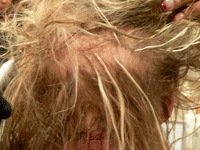
I went to a stylist and as she applied the hair ex- tensions, I noticed she was using glue. My first application was great, I could curl them and treat them just like it was my own hair. After a few days, after the newness had worn off, they felt very heavy and gave me extreme head- aches. I had a hard time blending them as they always looked stringy. Trying to brush my hair was difficult even with a special loop brush. I had my extension for about two months and struggled with them everyday. I went back to the salon and it took three hours to remove them.

The stylist convinced me there was no damage and I could do it again. The second application of extensions was worse. They were more of a struggle than the first. I had already lost some hair from the weight of the extensions, breakage, the glue, and chemicals used. When I had them removed the second time, the stylist did not want me to come to the salon to do it. We went to her home, I thought it was odd but I was desperate to get them out. My hair was completely damaged and broken. The dreadlocks could not be combed out, they needed to be cut out. I was at a point where I did not know what to do. I sought out advice from an extension expert.

According to her I had no choice but to put them back in my hair to hide the areas that had been thinned out even more. The new “hair extension expert” proceeded to apply extensions to the little hair that was left. Neither of these stylists informed me of any risks associated with hair extensions. There was no maintenance contract given to me, nor did they discuss the pros and cons with me. I assumed, like many others, that thousand’s of people get extensions so they know what they are doing. After all they are “licensed stylists.” Wrong! Six months into this and I did not know what to do. I was desperate and my hair was a mess.

I finally went to a hair restoration specialist, who in fact cringed when she saw my hair. She could not believe the damage that had occurred in only six months. I am thankful everyday that I made the decision to go see the hair restoration specialist. She managed to save my self esteem as a woman.


From Our Hair Restoration Specialist:
This story is not uncommon. On average this happens to about 80% of hair extension clients. One of the biggest misconceptions is that hair extensions are the only option to fix fine thin hair. In fact, there are hundreds of options from products, pieces, units and basic hair maintenance. It may even be determined that hair extensions are not the answer for you. There are pros and cons to each type of hair extensions. Information that should be discussed during your consultation include: hair and extension maintenance, application and removal frequency, any chemicals, glues or products used, hair type and your lifestyle. Lack of information and improper care are the biggest reasons people often have a bad experience. Hair extension baldness is the most common problem that results from improper application and removal of hair extensions. There are many times that the damage will be irreparable. If you notice any type of breakage, dreadlocks or your stylist does not allow you to see the back of your hair, you probably need some help. There is no easy solution in fixing the damage that extensions can cause.

Creating the best and healthiest environment is the your hair and scalp. A hair restoration specialist can recommend the right products and services that can, over time, restore your hair and repair the damage. Be sure to ask the proper questions, review all of your options and consult with more than one person. Also, ask the stylist if you can contact and see other clients with extensions. Do not be afraid to be told that you cannot have them. It may be a blessing in disguise. Do not go with the cheapest stylist and product either, they can cost you a lot more in damage and repair later. Do your research and educate yourself. It pays off in the long run.

For more information on Hair Extension Options...visit our Hair Extension Page on our Website!

This article was published In Northwest Womans Magazine in 2008! If you would like a copy of the article, please email info@crowningglorystudios.com

Wednesday, November 2, 2011

New Before and After Videos

Great New Before and After Pictures and options for Men, Women and Children Suffering from all forms of hair loss.

Crowning Glory Studios offers safe and healthy options to help enhance and restore your natural growing hair.

We specialize in hair extensions, scalp conditions, chemotherapy, genetic hair loss, alopecia and much more!


You can call today for a no obligation consultation at 509-926-6429 for a Spokane Appointment and 425-455-4247 for a Bellevue Appointment. We offer private rooms for your privacy and confidentiality!

Monday, September 19, 2011

Our Hollywood Leading Men - Their Hair or Not

More than ever, today's movie stars make more of an effort than Hollywood's "Golden Age" stars to conceal their hair loss from the public.

Recently, HairLossDotCom ran an article called “Hair Wearing Hollywood Stars” that looked mostly at movie stars of the past who disguised their hair loss on screen. This, clearly, is a situation that still exists today.

As a matter of fact, it could be argued that Hollywood stars today make even more of an effort to disguise receding hairlines, thinness and outright baldness than did the men who filled the silver screen in its so-called Golden Age.

Why should this be? Well, there are several reasons.

First, men in general – not just Hollywood stars, but everyday Joe’s – are more likely to be taking steps to disguise hair loss in order to feel more confident and comfortable in their daily lives.

Sixty years ago, a Jimmy Stewart or a Humphrey Bogart could afford to have sensational hairpieces created especially for them and styled and cared for by experts who knew just how to perpetuate the illusion that this hair sprang naturally from the stars’ heads. But the average man couldn’t afford that kind of toupee or service.

“There are plenty of actors who are rumored to ‘wear hair’ in some form or other. The question isn’t ‘Should they?’ so much as it is ‘Should we care?’”

In addition, alternatives like hair plugs and transplants were not really heard of. It wasn’t until the 1950s that grafting was tried as a means of treating baldness, and it would still be more than two decades before the process started to gain popularity.

Modern technology and artistic innovation offer more celebrities more hair loss treatments than before...

Gradually, however, as the country became more prosperous and as the demand for toupees and hair restorative techniques grew, these options became somewhat more affordable. More and more men sought solutions to their hair loss problems. And as the common man’s desire for hair systems increased, it became even more important for a star to maintain his “hair illusions.”

At the same time, however, society was undergoing a change that brought about what could be called the “Paparazzi Era”. We became more interested in learning about the real person beneath the carefully crafted facades of celebrities. We wanted to know what they ate, what they wore, whom they slept with, what they looked like without the careful ministrations of the make-up artist – and whether or not they wore hair.

This is understandable. Hollywood is all about creating a fiction. With rare exceptions, films are never intended to be taken as real. Yet they create a fictional world that is itself a kind of hyper-reality, which blows the stars into such larger-than-life characters that even as we admire them we want to catch at least a glimpse of their Achilles heels.

Not all celebrities are trying to hide their hair loss

Movie stars, of course, don’t want this to happen. Their careers are their lives, and their careers are built upon their public images. So as the paparazzi have become more and more aggressive in giving the public what it wants, the stars have become more aggressive in doing anything they can to guard their secrets.

Naturally, this isn’t true of every person. Patrick Stewart, Bruce Willis, Vin Diesel, Samuel L. Jackson and others freely sport a very liberating bald look. Billy Zane, who has better things to do than play cat-and-mouse with photographers, is also a member of that club.

But many others have to work hard to cover up any receding hairlines or bald patches.

  • John Travolta, who was “outed” for hair loss issues not too long, has been given a hard time. Maybe that explains why he’s adopting a totally bald look for an upcoming film.
  • Nicolas Cage’s hairline has receded and grown any number of times, leading many to suspect that the “National Treasures” star feels the public “treasures” a full head of hair on its leading men.
  • “Entourage” star Jeremy Piven’s career has had its ups and downs, as apparently so has his hairline.
  • Kevin Costner entered the world of conspiracy theories in “JFK.” Have photographs showing a changing hairline been doctored by an unknown assailant?
  • Hair plugs, toupees and extensions are said by some to be part of the worlds of stars such as Matthew McConaughey, Brendan Fraser and Ben Affleck.
  • Pierce Brosnan’s 007 might want to investigate whether SPECTRE is behind the sudden downward expansion of his hairline.
  • And after “The Da Vinci Code,” it’s hard to argue that SOMETHING isn’t going on with Tom Hanks’ hair.

There are plenty of others who are rumored to “wear hair” in some form or other. The question isn’t “Should they?” so much as it is “Should we care?” If wearing a toupee or getting hair plugs makes them feel more comfortable with themselves, or makes them feel more capable of giving a better performance, shouldn’t that be their right?

On the other hand, it could be argued that by covering up their balding states, these celebrities are perpetuating a view of men with hair loss as in some way inferior.

What do you think? Which other stars show signs of “hairline changes?” And do movie and TV stars have a right to their own “comfort zone” when it comes to revealing or not revealing their hair loss? Or do they have a responsibility as role models to “come clean?”


By HairLossDotCom